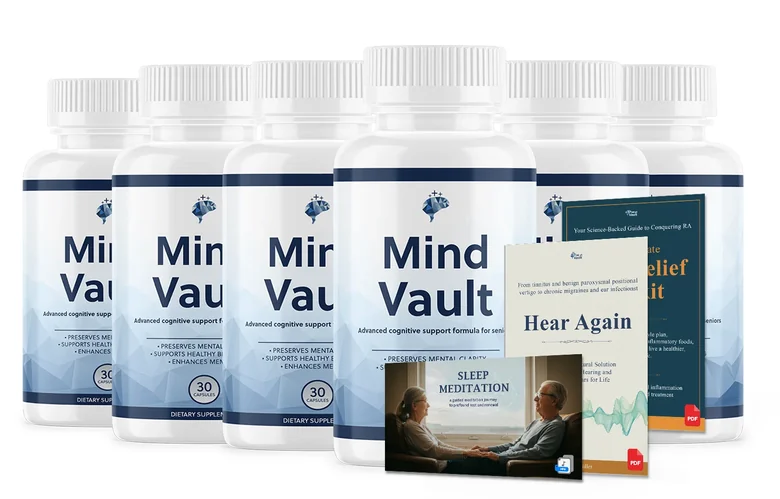
MindVault Reviews
MindVault customers consistently mention appreciating the named-ingredient transparency and non-stimulant feel, with results described as gradual.
The main criticisms are the lack of a dedicated clinical trial and individually varying results.
What customers consistently mention
Label transparency is frequently mentioned. Several reviewers specifically cite appreciating that every ingredient is named, rather than a vague blend.
Results build gradually. The most credible feedback describes small clarity improvements in the first week, with stronger memory and focus benefits typically reported after 2 to 4 weeks of consistent use, consistent with how the manufacturer frames expectations.
Customers value the non-stimulant feel. Reviewers frequently mention appreciating steady support without jitters or a crash, unlike stimulant-based alternatives.
Three customer accounts

“I appreciated that the label names every ingredient. Been taking it daily with breakfast for a couple of months.”

“Simple daily routine, easy to remember with breakfast. I went with the 3-bottle pack to give it a fair trial.”

“Glad it's framed honestly as brain wellness support rather than a miracle claim. That's what made me comfortable trying it.”
The common criticisms
No dedicated clinical trial on the finished product. The individual ingredients each carry some published research; the specific MindVault combination itself has not been separately tested.
Results vary and build gradually. As with any cognitive supplement, response depends on baseline health, consistency of use and individual physiology; some users report only mild change.
Single-bottle pricing is less efficient. Compared to the bundle options, the smallest package carries a considerably higher per-bottle cost.
An honest overall assessment
MindVault is a reasonably labelled cognitive wellness supplement, distinguished mainly by its seven-ingredient transparency and non-stimulant profile, spanning neurotransmitter support, neuron health, brain blood flow and calm focus. Its main limitation is that the finished formula has not been the subject of its own clinical trial, and it is not, and should never be marketed as, a treatment for dementia or Alzheimer's disease.
What it is not, under any framing, is a substitute for a proper medical evaluation of new, sudden or worsening memory changes — that remains a question for your doctor.